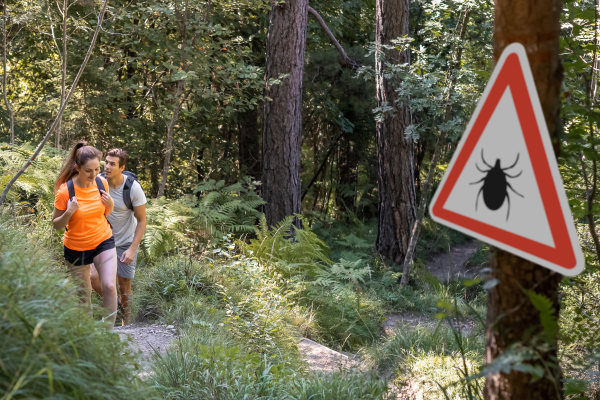
What is Lyme disease?
Lyme is a disease often carried by deer ticks, which are small bugs that live in grassy, brushy, or wooded areas. People who get Lyme disease usually get it from a deer tick bite in the spring, summer, or early fall.
Who is at high risk for Lyme disease?
People are at high risk for Lyme disease if they spend time where deer ticks live — grassy, brushy, or wooded areas particularly in the North Central, Northeast, and Mid-Atlantic regions of the U.S.
Visit the U.S. Center for Disease Control and Prevention's Lyme Disease Surveillance and Data page for the most up-to-date information, maps, and charts on Lyme disease cases reported within the U.S.

What can I do to prevent Lyme disease?
Before being outside in an area with ticks:
- Wear protective clothing, including long pants and long sleeves.
- Treat your gear. Spray your clothes, tent, and other fabrics with permethrin 0.5%, which kills ticks. Plan ahead since it can take a few hours to dry. (Note: This spray is not safe for skin.)
- Use tick repellent on your skin. Find the right repellent for you, depending on how long you need protection and if you’ll also be in an area with mosquitoes.
After being outside in an area with ticks:
- Check all clothing and gear for ticks. If you find any ticks on your clothes, put the clothes in a tumble dryer for 10–15 minutes or wash them in hot water to kill the ticks.
- Check your whole body (head-to-toe) thoroughly for ticks and tick bites. Pay close attention to warm, hidden spots like behind your ears, under your arms, around your groin, and between your toes.
- Take a shower within 2 hours. A shower helps wash away any unattached ticks and is also a good opportunity to check your body for attached ticks.
What do I do if I find a tick or tick bite on my skin?
Don’t panic! The odds of getting Lyme disease within 24 hours of a tick bite are very low.
If you find a tick on your skin, follow steps to carefully remove it.
If you find a small, red bump on your skin, it may be a tick bite. Keep an eye out for the symptoms noted below.
When should I seek medical care?
Reach out to your Firefly care team if: You’ve been outside in an area with ticks anytime in the last 30 days AND one or more of the following applies...
- You find a tick on your body: Contact your provider ASAP — treatment is most effective if you start it within 72 hours of a tick bite.
- You notice a bite that looks unusual: For example, a bull’s-eye rash (circular area of redness with a clear center) or a dark spot at the bite’s center.
- You get flu-like symptoms: For example, fever, headache, muscle aches, or fatigue.
Symptoms of Lyme disease can start 3 to 30 days after a tick bite, so be on the lookout for symptoms for up to a month.
If I get bitten by a tick with Lyme disease, will I definitely get Lyme disease?
No. Even if the tick is carrying Lyme disease, you might not get it. It also takes time for a tick to transmit Lyme — so if you get treatment early, you can further lower your chances of getting the disease. Reach out to your Firefly care team to learn more.
What happens if Lyme disease develops and goes untreated?
Within 3 to 10 weeks, symptoms can get much worse:
- Meningitis (swelling of the outer layer of the brain and spinal cord)
- Nerve pain
- Tingling, prickling, burning, or numbness in the hands or feet
- Swelling of the heart
- Eye problems, like conjunctivitis, keratitis, uveitis
- Bluish-red rash with swelling (most common in Europe)
In the late stage of Lyme disease, other symptoms can develop:
- Arthritis in large joints, especially the knee
- Changes in cognition (the ability to think, learn, or remember)
If I develop new Lyme disease symptoms over time, is there treatment available?
Yes. Lyme disease tends to be treated with antibiotics. Reach out to us right away so we can figure out the right treatment for you.
References
- Mayo Clinic. (February 10, 2023). Lyme disease. https://www.mayoclinic.org/diseases-conditions/lyme-disease/symptoms-causes/syc-20374651
- CDC. (July 15, 2025). What to Do After a Tick Bite. https://www.cdc.gov/ticks/after-a-tick-bite/index.html
- American Forests. (2025). Tick Checking 101: Steps to Take For Every Hike. https://www.americanforests.org/article/tick-checking-101-steps-to-take-for-every-hike/